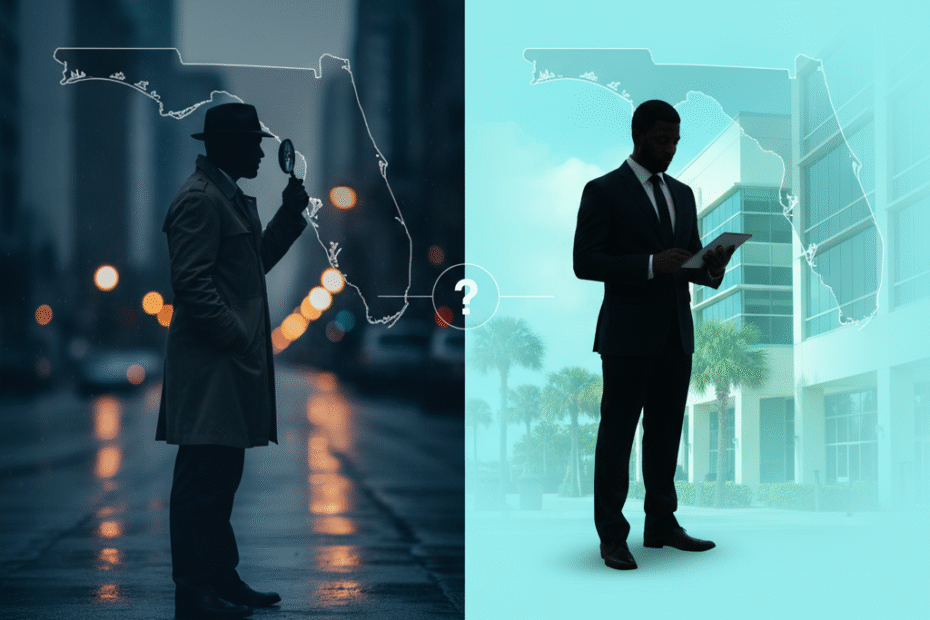
Can you become a detective without being a police officer in Florida? The short answer: yes — but the words matter more in popular culture than in the law. Understanding private detective vs private investigator Florida differences matters if you want to launch a career in private investigation, obtain the right license, and set realistic salary and business expectations in Florida’s market.
Many aspiring investigators mix up terms from TV dramas. This guide clarifies what Florida law and industry practice actually mean, how licensing under Florida statute chapter 493 works, and practical next steps for people aged 20–45 who want to enter the field without prior law enforcement experience.
Quick Overview: Key Points about private detective vs private investigator florida differences
- No legal distinction in Florida: The terms are commonly interchangeable for private, non‑police investigators. SRecon and other industry sources confirm this.
- Licensing requirement: Most paid investigators in Florida must hold a Class “C” license under chapter 493 unless they are an exempt in‑house investigator. See CTK Investigations.
- No police powers: Private investigators cannot arrest or access some law enforcement-only databases. This distinguishes them from sworn detectives working for police agencies (GIC).
- Typical work: Surveillance, background checks, missing-person searches, fraud and financial investigations, and evidence gathering for civil cases.
Definitions and Legal Meaning in Florida: private detective vs private investigator florida differences
What Florida law and industry sources say
In Florida, the labels private detective and private investigator are used interchangeably in practice. Industry resources state there is little difference in meaning when referring to private, fee‑based investigators working outside government agencies (SRecon).
How private investigators differ from sworn detectives
Compare the two like this:
- Sworn detectives (police): Employed by government, have arrest powers, access to law enforcement databases and crime scenes, and wear badges.
- Private investigators/detectives (private): Work for private clients or agencies, have no arrest powers, must gather evidence within civil and criminal legal boundaries, and cannot access the full suite of police-only resources (GIC).
Licensing, legal limits, and how evidence must be handled in Florida

Class “C” license: who needs it?
Florida requires most investigators who provide services for a fee and operate through an agency to hold a Class “C” private investigator license under chapter 493. The rule is intended to ensure training, background checks, and accountability for consumer protection. The CTK Investigations FAQ explains common licensing scenarios.
In-house investigator exemption
An important exception is the in-house investigator who works exclusively for a single employer (for example, a large corporation or insurance company). These investigators typically don’t need a Class “C” license so long as they do not offer services to the public.
Legal limits and admissible evidence
Private investigators must follow privacy, wiretapping, and trespass laws. Evidence gathered must be collected legally to be admissible in court — that means no illegal recording, no impersonating law enforcement, and no trespassing. Remember: although the job may feel like detective work, PIs remain private citizens with private tools.
How to become a private investigator in Florida without police experience
Step-by-step career pathway
- Meet basic education requirements: At minimum, a high school diploma or GED; many entry-level roles accept candidates with some college or vocational training.
- Get experience: Work in related fields like security, loss prevention, or compliance to build investigative skills and references.
- Apply for a Class “C” license: Complete any state-required training, background checks, and fingerprinting as specified in chapter 493 and verified by Florida licensing entities (CTK Investigations).
- Gain on‑the‑job training: Many agencies hire less-experienced investigators and provide mentorship; specialization (cyber, financial, surveillance) increases marketability.
- Consider starting your own agency: After years of experience and fulfilling licensing/business requirements, you can operate independently or hire staff.
Real-world context: a hypothetical example
Maria, 28, left a security job and completed Florida’s licensing steps. She started as an associate investigator at a private firm, learning surveillance and public records searching. Within three years she specialized in background checks for small-business clients and later launched her own licensed agency. This typical path shows how non-police backgrounds can transition into licensed investigative careers.
Earnings, demand, and practical realities for Florida job seekers
Salary and job outlook
National data from the Bureau of Labor Statistics lists a median annual wage of about $52,370 for private detectives and investigators, with steady demand in many regions, including Florida (BLS). Actual Florida pay varies by experience, specialization, and whether you work for a firm or run your own business.
Pros, cons, and common misconceptions
- Pros: Independence, flexible hours, entrepreneurial opportunities, and varied casework (surveillance, fraud, background checks).
- Cons: Irregular income early on, legal constraints on what you can do, and the need for meticulous record-keeping to ensure admissible evidence.
- Misconception: PIs have police powers. They do not — they must operate within civil law and criminal statutes (GIC).
Specializing (e.g., cybersecurity investigations or insurance fraud) and building a reputation for legally solid evidence increases earning potential and job stability.
Final steps and recommended next actions for aspiring investigators
To move forward, do these three things:
- Read Florida statute chapter 493 and confirm Class “C” license requirements with the state licensing authority.
- Gain hands-on experience in related fields (security, compliance, loss prevention) and pursue training in surveillance and records research.
- Network with licensed private investigators and agencies, and consider mentorship or apprenticeship opportunities to learn courtroom‑ready evidence handling.
Summary: Understanding private detective vs private investigator Florida differences clarifies that the terms are largely synonymous in Florida for private practitioners, but the key distinctions are between private investigators and sworn detectives with police powers. Follow Florida’s licensing rules (Class “C” and in‑house exemptions), prioritize legal evidence collection, and plan realistic salary expectations as you build a career in private investigation.
Sources: SRecon, CTK Investigations, GIC, BLS Occupational Outlook.